About us!

We are Amisadai and Louisa Monger (aged 15 and 13). In 2010, we moved to Tanzania in Africa - look at the map below to see if you can find it! We hope you will enjoy reading about our adventures and looking at our photos! Please don't forget to send us a message too!


Monday, 12 August 2013

Teasing Mr Crocodile, "You can't catch me!"

TODAY'S NEWS!

Our rabbit gave birth to 5 baby rabbits! I have been waiting for a long time for baby bunnies to arrive!

We found out that Elly (our guard) had been to feed the rabbits at 10 o clock last night and saw that the babies had been born. It' s good news they survived the night! If they are alive tomorrow there is a good chance they will survive, unless the dogs get them.😢


River Fishing!

When we were in Kimunde, we went fishing! We have to walk across the football pitch and down a path through thornbushes. Then you can see a line of green, where the river is. When you get to the green, it is amazing. Our friend, Mama Sungura has a huge garden there. Find out why we call her Mama Sungura by looking at the Swahili page to see what Sungura means! Her real name is Mama Kristina! In her garden, she grows lots things like eggplant, spinach, papaya, bananas, and tomatoes. We go through the garden to get to a good fishing point.


Can you see where the river is?
We fished the Tanzanian way. We asked Mum for her headscarf and used it to catch the fish. They also use khangas (the cloth that ladies wear as a skirt). We got in the river and held the corners of the khanga and gently pushed it into all the weeds on the side. Louisa thrashed the weeds with her stick. All the fish in that area (if there are any) then swim into the khanga. Then we quickly pulled up the khanga and let all the water drain out. Then we opened it up to see if there were any fish. Salma wore a khanga in a special position so that it makes a pouch that she could put all the fish in. We just went along the edges of the river where we caught small fish. The first day we went with Salma and Ellis. We caught sixteen small fish that time! We got two dagaa (that smelly small type of fish people sell in the market) and fourteen of another type. (I can’t remember the name!) The second time we went, we went with Salma again as well as Diana. We caught about fourteen little fish (about five dagaa) and one big one!! We also caught a snake which made us all have a little panic and splash back to shore in a hurry. But it was a little water snake and Salma said it wasn’t a bad one.

We caught some!


Dagaa and a little fish

A big one! 
We took our fish back to Salma’s house and got the three stone fire going (they don’t have a fuel-efficient stove yet). We washed the fish. Cleaning the insides of the big fish was a bit gross. We put some oil and salt in a pan and then added all the little fish and the big one. We soaked some rice while they were cooking. We found an onion and two tomatoes in Salma’s house and prepared a sauce on another fire. And then we cooked the rice. When it was all ready we took a plate of the food to Mum and Dad to try. Then we all ate the rest of it. It was so much fun.

Cooking the fish


We found out afterwards from Mama Violet that there are crocodiles in that river! But we didn't see them and we didn't tease them ... and I’m glad they didn’t have me for tea.


These boys were using poles!


Saturday, 10 August 2013

A Guided Tour of our House in Kimunde

While we were in Kimunde we thought we would do a video blog with the camera as we don't have a computer there! So watch here for a guided tour of where we live, our house in Kimunde.


Our House in Kimande, Tanzania from Rachel Monger on Vimeo.

If you have questions about what it is like where we live or would like to see videos or photos of other things there, please email us or comment here on the blog to let us know and we'll come back soon with answers for you!

Wednesday, 24 July 2013

How Do We Get Honey (by Louisa)

We have been harvesting honey! So today we learned a bit about how we get honey!

How do we get honey?
We get honey from bees. Bees get pollen from the flowers and then the bees go back to their hive with the nectar in their nectar sac. They give the nectar to the house bee and she chews it for half an hour and it turns into sugar. She puts this in the honeycombs, little hexagonal pockets and it turns into honey in there. When the pocket is full, the bee puts a lid of wax on the top. Then you can take the honey out.

Getting the Honey
Mbwilo, our guard, came at night time to get our honey. We all went out to watch (but didn't want to get too close to the bees). He had a net over him and wore rubber gloves. He made a smoky fire to smoke the bees out. Then he got all the honeycomb out of the hive and put it all in three big buckets. He brushed the bees off the combs with a rosemary branch.

Smoking out the bees

Honey in the honeycomb ... and lots of bees!

Brushing the comb with rosemary

 
The next day, we mashed up the honeycomb and then sieved the honey through a mosquito net. We hung the mosquito net up high with string and hung it over the bucket to let it drip into the bucket. It is still dripping!


I had honey toast for lunch. Do you like honey?  I love honey, it makes you funny. Mum thinks I've had too much honey!

Tuesday, 16 July 2013

Baby Amisadai and Village Life

I thought I would tell you a bit about what it is like living in Kimande. Here is a photo of me washing our clothes. We get some water from the water point outside and then pour water and soap powder in a bucket and wash the clothes with our hands. Then we rinse the clothes and then rinse them again! The water gets very dirty because the clothes are so dirty! A few kids came to watch me when I was washing and then the audience grew!
Washing clothes in the shade.

More kids came to watch!
I love the donkeys that wander around the village! But I don't like the noise they make. I tried to go and pat this donkey, but it ran away! The donkeys are used to pull carts.


Washing dishes in Kimande is a very different job compared to England. There is no electricity, so no dishwasher. We get water from the water point outside and fill bowls to wash and rinse. The sufurias (metal cooking pots) get very black from the fire and it doesn't rinse off in water. So you use dirt from the ground with some water and scrub with your hands very hard. It doesn't seem like it would work because it makes it dirtier! But really when you wash off the mud, it is shiny silver again! Here is a photo of Mummy washing a sufuria outside our house.


Singing for the team in the Kimande Church
Last week in Kimunde, a team from England came to visit our house. There were 14 of them! They had been staying in The Neema Craft guest-house. When they came to Kimunde, they stayed for a cup of Tanzanian chai (tea). A few of them said was too sweet! We took them round the village to places like the office of the Pawaga Officer, the church and the hospital. At the office, we had sodas! At the church we did some singing and drumming. But the hospital was the most exciting thing. We saw a two-hour-old baby girl! The mum (a relative of Mendriad's) was very tired. But she didn't have a name for the baby yet.


Going to this hospital is not at all like going to the hospital in Basingstoke! You walk on hot sand with the scorching sun shining on you. The ground is hard and thorny. At the hospital, there is no gate or barrier. It is all open. There are quite a few one layer buildings, all for different things. One for injections, one for having babies, one for men and one for women. The one for giving birth is very unlike ones in Canada and England, there are only three beds, which have no sheets, only plastic, which are not very clean. The rooms are very small. But next door is a sitting area, where guests to see patients can sit.

We went to see the baby again later that day, after the team had left. She is lovely. But she still didn't have a name! The next day we went, and the mum was not so tired then. They didn't have a name and they asked me to think of one! I said Sophie, because that is the name of one of my friends in Aldermaston. They asked for another name and I couldn't think of one but I told her my name and asked if they like that. They said yes, and so the baby is called Amisadai! They even wrote it on the medicine box! They had to stay in the hospital for a few days as the mama had lost blood and had a poorly heart. The nurse said they needed to find someone in her family to care for her so that she could rest when she left, before they would let her leave the hospital. The hospital is a short walk from our house and I visited them every day.


Amisadai, Amisadai and the Nurse


Me and Baby Amisadai

Friday, 28 June 2013

Chocolate Brownies and $15 000 Giraffes

Do you know one of the best places to go out for coffee? It is the Greek Club in Iringa! We went there for a treat with Grandma and Grandad! They have the best brownies with strawberries and real cream! And when the adults get their coffee, it comes with real grated chocolate which they let me have in the milk! Yum! There is also a really good playground with a playhouse and swings. If you come to Tanzania, you should go there!

The Greek Club Brownie (without cream)
 
Our new dresses from Grandma (we are doing a silly dance)

Celebrating Dad's Birthday!


Last week we went to Kipepeo Beach in Dar es Salaam. Kipepeo means butterfly in Swahili. We went there with Grandma and Grandad when they were leaving to go back to England. The waves were strong, they knocked over all us in the water! I tried to run back to the shore to beat a big wave. But it beat me and knocked me right under the water. We have been learning about coasts and the seaside with Grandma. We learned about sand dunes and cliffs and creatures. At Kipepeo, it was very sandy - the sand was very hot and burned our feet! There are lots of jelly fish there, but we didn't get stung. We saw fish swimming below us in the clear water and fishermen with their nets. 

Kipepeo Beach
 
It was so crowded getting on the ferry on our way to Kipepeo!
On the way home from Dar, we saw lots of animals in the gamepark. A giraffe crossed the road in front of us. It was good that we didn't hit it, because then we would have to pay $15 000!

Here is a list of what you have to pay if you hit animals on the road through the gamepark. Most expensive is a twiga (giraffe) and a tembo (elephant). But you would not kill an elephant I don't think, because they are so BIG!
 
Today I had to say good bye to my friend, Kaiya. She is going back to Australia until January. She is seven years old like me and we love playing together. I am going to miss her.


Thursday, 6 June 2013

Pease Porridge, Tea and Bones


Remember all those bone questions in my last blog? Well, here are the answers!

1. One adult has 206 bones. Younger children have less.
2. To smile, 17 muscles are used.
3. To frown, 42 have to work... so it is a much better idea to smile :)
4. Bones do grow
5. No, skeletons are not always inside the body. Creatures such as a crabs or snails have their skeletons outside their body called exoskeletons.

Well done, Jake, from Jake's Bones Blog. You were the only one who answered all the questions! You must be a bone expert!

TEA LEAVES
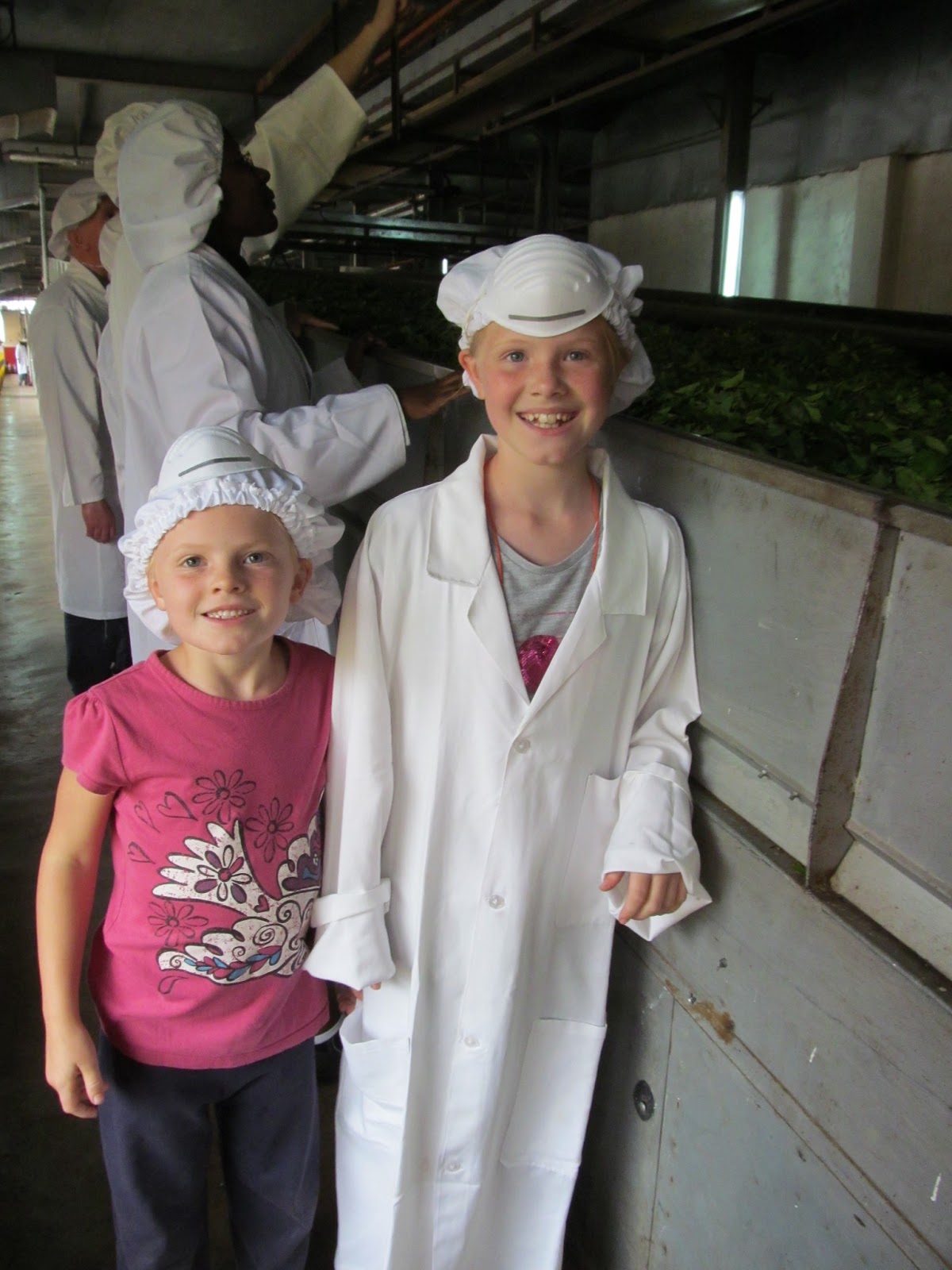
Last week, we went to the tea factory in Mufindi! We dressed up in long white coats, masks, caps and even earplugs!

Tea Experts!
First we went to the head office and then we started on our finding-out tour with Esther, our guide. I have a slide show to show you what we learned ... coming soon!


Taste Test


If you come from England, look out for Lipton tea. 80% of the tea from the Mufindi factory is sold  to Lipton UK (it used to go to PG Tips). So next time you buy tea, look at where it comes from. It just might say "FROM TANZANIA!" Here it is sold as Chai Bora which means "better tea."

MEDIEVAL DAY
Last week we had Medieval Day! It was great fun. We did activities and games first, and then we started to get ready for our Medieval Feast. We put hay over the floor and set the table with candles and only bread instead of plates! We ate with our fingers by candlelight! We had pork on sticks, pease porridge, eggs, and potatoes. We had yummy honey tarts for pudding.


Pease Porridge Hot

Between courses, Louisa the Jester entertained with juggling and jokes.
Knock-knock. Who's There? Jester. Jester who? Jester minute and I'll unlock the door!
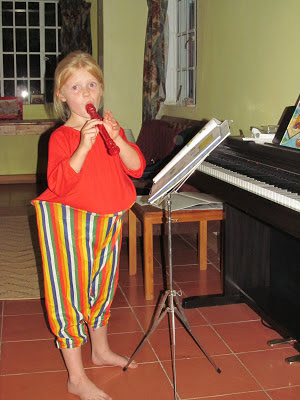

Louisa the Jester

I was a Minstrel and entertained with medieval music on the stringed instrument. And after dinner there was story-telling with puppets.

Also last week, before we went to the tea factory, we went to teach healthy and efficient cooking on the jiko (clay stove) to the Bible School students. I was in charge of the visual aids. Louisa made sauce. Both of us washed everyone's hands before we all ate the food at the end. It was fun. 


Wednesday, 22 May 2013

Cooking with Cow Poo

COW POO COOKER

Next door they use cow poo to cook their food! This is a very good way of saving electricity. Just by using cow poo! Here is how it works:


The cow poo
Put three buckets of cow dung (take the straw out first) and three buckets of water down into a cement tank. There are two tanks.

Putting in the poo

The cement tanks
The dung is very smelly and makes a gas which rises the top of the tank. It then goes through a pipe to the kitchen where it is attached to a gas stove. Then they can turn on the oven and cook their food!

The pipe going to the kitchen

It is called a Biogas Stove.
 
BONES!
We have been learning about bones and skeletons at school. Look at all the bones we have found! Well, actually, we took this photo a long time ago and we now have a lot more. The biggest bone, is from Ben Wingfield. He found it in a village and the villagers said that it was the jaw-bone of a cow. Here are some bone and muscle questions for you! We will give the answers in the next blog!

1.  Do you know how many bones you have in your whole body?
2. How many muscles do you use to smile?
3. How many muscles do you use to frown?
4. Do your bones grow?
5. Is a skeleton always inside the body?

I hope you can answer some! I have a joke as well!

Why didn't the skeleton go to the party?
Because he had no body to go with!


This is just a very short and funny story which happened the other day..
There was a man next door who wanted his mangoes from his mango tree. So he shook his mango tree. Nothing came. He shook again, a little harder. Again, nothing came. This time he shook as hard as hard as he possibly could. Then there was a rainstorm of mangoes. One mango fell on to his head, and then fell off and jumped to the ground! Ouch!

Did you notice we have a new page next to the Swahili page? You can find out about books we have enjoyed. We'll try to add more as we read more. But we'd also like to know what good books you have read so we get some good ideas of books we can read! Thanks!

Lastly, I thought you might like to look up my friend, Tianna's blog. She is from Australia and lives in Iringa and is blogging about Tasmanian Devils.  Go to "Save our Tasmanian Devil" to find out more!

Actually one more thing ... we are going to Dar es Salaam tomorrow to pick up my Grandma and Grandad! Isn't that exciting? And Dad will go to the dentist and we are doing a school assembly and we are going to try and find some plastic bags to make it easier for Mama Lucy to sell her cinnamon buns!


The cement tanks