About us!

We are Amisadai and Louisa Monger (aged 15 and 13). In 2010, we moved to Tanzania in Africa - look at the map below to see if you can find it! We hope you will enjoy reading about our adventures and looking at our photos! Please don't forget to send us a message too!


Tuesday, 16 July 2013

Baby Amisadai and Village Life

I thought I would tell you a bit about what it is like living in Kimande. Here is a photo of me washing our clothes. We get some water from the water point outside and then pour water and soap powder in a bucket and wash the clothes with our hands. Then we rinse the clothes and then rinse them again! The water gets very dirty because the clothes are so dirty! A few kids came to watch me when I was washing and then the audience grew!
Washing clothes in the shade.

More kids came to watch!
I love the donkeys that wander around the village! But I don't like the noise they make. I tried to go and pat this donkey, but it ran away! The donkeys are used to pull carts.


Washing dishes in Kimande is a very different job compared to England. There is no electricity, so no dishwasher. We get water from the water point outside and fill bowls to wash and rinse. The sufurias (metal cooking pots) get very black from the fire and it doesn't rinse off in water. So you use dirt from the ground with some water and scrub with your hands very hard. It doesn't seem like it would work because it makes it dirtier! But really when you wash off the mud, it is shiny silver again! Here is a photo of Mummy washing a sufuria outside our house.


Singing for the team in the Kimande Church
Last week in Kimunde, a team from England came to visit our house. There were 14 of them! They had been staying in The Neema Craft guest-house. When they came to Kimunde, they stayed for a cup of Tanzanian chai (tea). A few of them said was too sweet! We took them round the village to places like the office of the Pawaga Officer, the church and the hospital. At the office, we had sodas! At the church we did some singing and drumming. But the hospital was the most exciting thing. We saw a two-hour-old baby girl! The mum (a relative of Mendriad's) was very tired. But she didn't have a name for the baby yet.


Going to this hospital is not at all like going to the hospital in Basingstoke! You walk on hot sand with the scorching sun shining on you. The ground is hard and thorny. At the hospital, there is no gate or barrier. It is all open. There are quite a few one layer buildings, all for different things. One for injections, one for having babies, one for men and one for women. The one for giving birth is very unlike ones in Canada and England, there are only three beds, which have no sheets, only plastic, which are not very clean. The rooms are very small. But next door is a sitting area, where guests to see patients can sit.

We went to see the baby again later that day, after the team had left. She is lovely. But she still didn't have a name! The next day we went, and the mum was not so tired then. They didn't have a name and they asked me to think of one! I said Sophie, because that is the name of one of my friends in Aldermaston. They asked for another name and I couldn't think of one but I told her my name and asked if they like that. They said yes, and so the baby is called Amisadai! They even wrote it on the medicine box! They had to stay in the hospital for a few days as the mama had lost blood and had a poorly heart. The nurse said they needed to find someone in her family to care for her so that she could rest when she left, before they would let her leave the hospital. The hospital is a short walk from our house and I visited them every day.


Amisadai, Amisadai and the Nurse


Me and Baby Amisadai

Friday, 28 June 2013

Chocolate Brownies and $15 000 Giraffes

Do you know one of the best places to go out for coffee? It is the Greek Club in Iringa! We went there for a treat with Grandma and Grandad! They have the best brownies with strawberries and real cream! And when the adults get their coffee, it comes with real grated chocolate which they let me have in the milk! Yum! There is also a really good playground with a playhouse and swings. If you come to Tanzania, you should go there!

The Greek Club Brownie (without cream)
 
Our new dresses from Grandma (we are doing a silly dance)

Celebrating Dad's Birthday!


Last week we went to Kipepeo Beach in Dar es Salaam. Kipepeo means butterfly in Swahili. We went there with Grandma and Grandad when they were leaving to go back to England. The waves were strong, they knocked over all us in the water! I tried to run back to the shore to beat a big wave. But it beat me and knocked me right under the water. We have been learning about coasts and the seaside with Grandma. We learned about sand dunes and cliffs and creatures. At Kipepeo, it was very sandy - the sand was very hot and burned our feet! There are lots of jelly fish there, but we didn't get stung. We saw fish swimming below us in the clear water and fishermen with their nets. 

Kipepeo Beach
 
It was so crowded getting on the ferry on our way to Kipepeo!
On the way home from Dar, we saw lots of animals in the gamepark. A giraffe crossed the road in front of us. It was good that we didn't hit it, because then we would have to pay $15 000!

Here is a list of what you have to pay if you hit animals on the road through the gamepark. Most expensive is a twiga (giraffe) and a tembo (elephant). But you would not kill an elephant I don't think, because they are so BIG!
 
Today I had to say good bye to my friend, Kaiya. She is going back to Australia until January. She is seven years old like me and we love playing together. I am going to miss her.


Thursday, 6 June 2013

Pease Porridge, Tea and Bones


Remember all those bone questions in my last blog? Well, here are the answers!

1. One adult has 206 bones. Younger children have less.
2. To smile, 17 muscles are used.
3. To frown, 42 have to work... so it is a much better idea to smile :)
4. Bones do grow
5. No, skeletons are not always inside the body. Creatures such as a crabs or snails have their skeletons outside their body called exoskeletons.

Well done, Jake, from Jake's Bones Blog. You were the only one who answered all the questions! You must be a bone expert!

TEA LEAVES
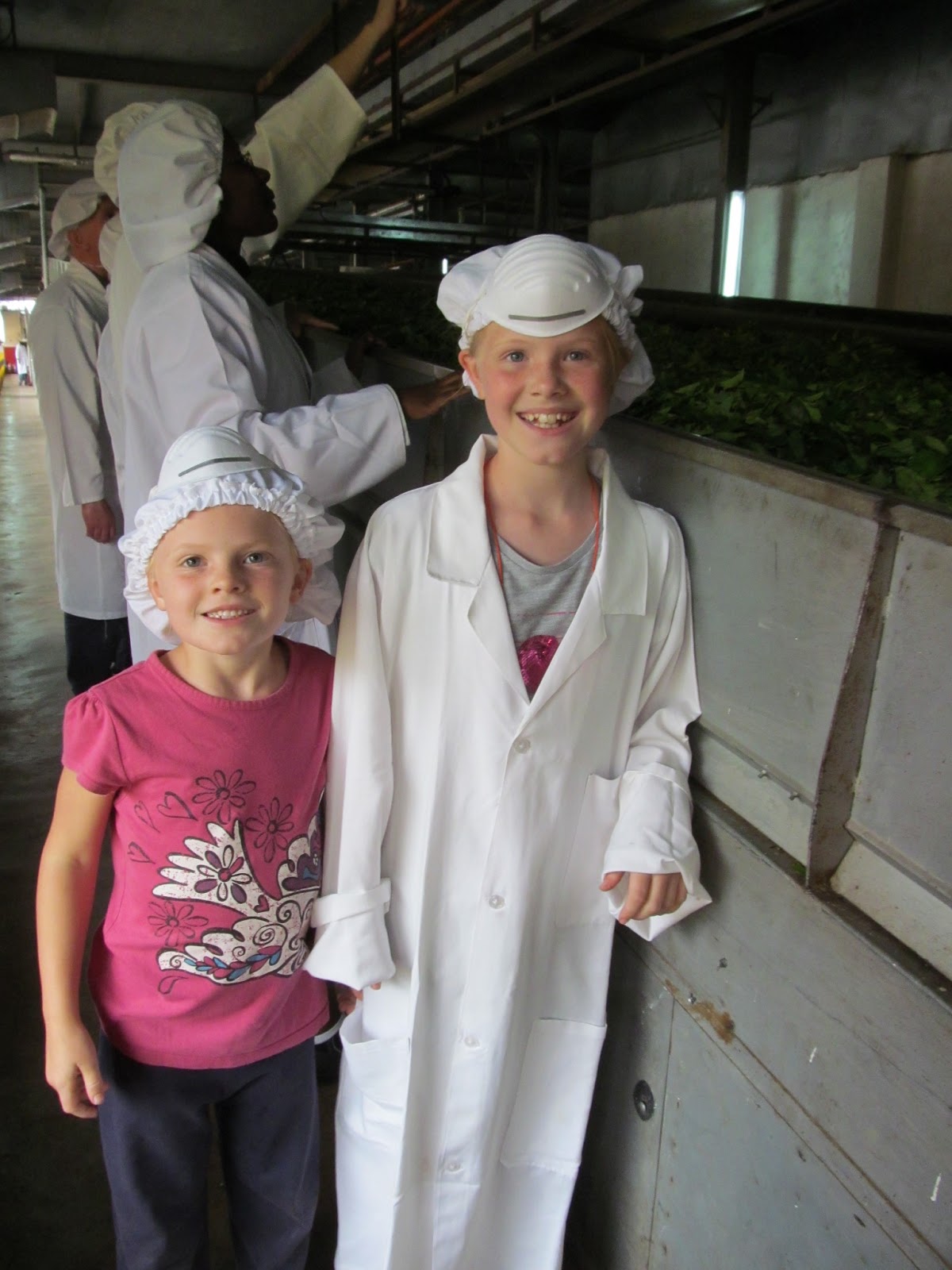
Last week, we went to the tea factory in Mufindi! We dressed up in long white coats, masks, caps and even earplugs!

Tea Experts!
First we went to the head office and then we started on our finding-out tour with Esther, our guide. I have a slide show to show you what we learned ... coming soon!


Taste Test


If you come from England, look out for Lipton tea. 80% of the tea from the Mufindi factory is sold  to Lipton UK (it used to go to PG Tips). So next time you buy tea, look at where it comes from. It just might say "FROM TANZANIA!" Here it is sold as Chai Bora which means "better tea."

MEDIEVAL DAY
Last week we had Medieval Day! It was great fun. We did activities and games first, and then we started to get ready for our Medieval Feast. We put hay over the floor and set the table with candles and only bread instead of plates! We ate with our fingers by candlelight! We had pork on sticks, pease porridge, eggs, and potatoes. We had yummy honey tarts for pudding.


Pease Porridge Hot

Between courses, Louisa the Jester entertained with juggling and jokes.
Knock-knock. Who's There? Jester. Jester who? Jester minute and I'll unlock the door!


Louisa the Jester

I was a Minstrel and entertained with medieval music on the stringed instrument. And after dinner there was story-telling with puppets.

Also last week, before we went to the tea factory, we went to teach healthy and efficient cooking on the jiko (clay stove) to the Bible School students. I was in charge of the visual aids. Louisa made sauce. Both of us washed everyone's hands before we all ate the food at the end. It was fun. 


Wednesday, 22 May 2013

Cooking with Cow Poo

COW POO COOKER

Next door they use cow poo to cook their food! This is a very good way of saving electricity. Just by using cow poo! Here is how it works:


The cow poo
Put three buckets of cow dung (take the straw out first) and three buckets of water down into a cement tank. There are two tanks.

Putting in the poo

The cement tanks
The dung is very smelly and makes a gas which rises the top of the tank. It then goes through a pipe to the kitchen where it is attached to a gas stove. Then they can turn on the oven and cook their food!

The pipe going to the kitchen

It is called a Biogas Stove.
 
BONES!
We have been learning about bones and skeletons at school. Look at all the bones we have found! Well, actually, we took this photo a long time ago and we now have a lot more. The biggest bone, is from Ben Wingfield. He found it in a village and the villagers said that it was the jaw-bone of a cow. Here are some bone and muscle questions for you! We will give the answers in the next blog!

1.  Do you know how many bones you have in your whole body?
2. How many muscles do you use to smile?
3. How many muscles do you use to frown?
4. Do your bones grow?
5. Is a skeleton always inside the body?

I hope you can answer some! I have a joke as well!

Why didn't the skeleton go to the party?
Because he had no body to go with!


This is just a very short and funny story which happened the other day..
There was a man next door who wanted his mangoes from his mango tree. So he shook his mango tree. Nothing came. He shook again, a little harder. Again, nothing came. This time he shook as hard as hard as he possibly could. Then there was a rainstorm of mangoes. One mango fell on to his head, and then fell off and jumped to the ground! Ouch!

Did you notice we have a new page next to the Swahili page? You can find out about books we have enjoyed. We'll try to add more as we read more. But we'd also like to know what good books you have read so we get some good ideas of books we can read! Thanks!

Lastly, I thought you might like to look up my friend, Tianna's blog. She is from Australia and lives in Iringa and is blogging about Tasmanian Devils.  Go to "Save our Tasmanian Devil" to find out more!

Actually one more thing ... we are going to Dar es Salaam tomorrow to pick up my Grandma and Grandad! Isn't that exciting? And Dad will go to the dentist and we are doing a school assembly and we are going to try and find some plastic bags to make it easier for Mama Lucy to sell her cinnamon buns!


The cement tanks


Monday, 20 May 2013

Louisa Reports on Medieval Clothes

What Did People Wear In Medieval Days?

People in Medieval days lived almost one thousand years ago. They wore different clothes made out of different textiles. I am going to tell you about the different outfits that Medieval people wore.

Textiles: What were clothes made of?

Most people wore clothes made of linen and wool. Peasants would spin and weave the thread and wool and make colourful designs. They used sheepskin to make warm cloaks. They used leather to make shoes. But textiles of the wealthy people were different. They had clothes made of velvet, fur, brocade, silk, in bright colours. The king even had cloth of gold for his clothes.  The wealthy got their textiles from exotic places of the far East, Spain and Italy.

Knight’s Armour

Knights in the High Middle Ages wore chain mail over there whole body. Chain mail is called “hauberk” and is made out of iron rings linked together. On the top of the chain mail they wore a tunic called a “surcoat.” This was to keep the sun off the metal which got hot. On the surcoat they put on their flag, colours or coat-of-arms.

In the late Middle Ages knights started to where plate armour. Steel plates covered the knight’s body. The plates had joints so the knights could move around. They started to where helmet’s with visors.
Sometimes, a knight’s horse wore armour too. They wore metal plates and wore a linen surcoat.

The textile, metal, used by the knights was good because it gave protection. But it was very hot and very heavy and so hard to move.


Serfs Clothing

The serfs, or the common peasants, wore simple, sensible clothes. They wore a tunic with long narrow sleeves. They wore a hood with a “linipipe” which was used as a scarf. Even though their clothes were simple, they liked wearing colourful clothes. The men wore big, baggy underwear called “braies.” Women wore petticoats called “kirtles.” Women also wore a head covering called a “wimple.”

Clothes of the King and Nobility

The wealthy Lords and Ladies wore expensive clothes. They made clothes with bright and fancy textiles from far away places. The ladies wore long trailing dresses with wide sleeves.  Men also wore wide long sleeves and long tunics. They wore long, pointy shoes. Ladies wore different types of headdresses: padded roll, templers (coils of hair on the ears), horned headdresses with a veil and steeples (tall cone hats with streamers).

 
If I was to wear Medieval clothes, I would actually choose to wear a Jester’s outfit. They wore bright funny clothes to make people laugh! What would you wear?


Sunday, 12 May 2013

Making a Fridge without any Electricity

Exciting news! We now have two kittens! I love them! We finally got some to catch the rats. But they have to stay away from Dad who is allergic to them! We have called them Kettle and Wotsit. It is EI tradition to name cats after crisps/chips. EI cats have been called Pringle, Pretzel, Hula and Hoop, Twiglet ... so it was hard to think of new names! What would you call a cat if you had to name him or her after crisps?


We made a fridge this week! We had to make something that we could mature our cheese in - a place that is cool and slightly damp. So we made a clay cooler and here is how we did it!

First we collected buckets of sand.
 
And had some fun in the sand too!


We scrubbed out clay pots.

We put sand in the bottom of the big clay pot.

We put a small clay pot inside the big clay pot and put lots of sand in between.


We made the sand wet with water.


We tested the temperature and the humidity inside. For maturing cheese, we needed a temperature of abut 12C and 70% humidity. It wasn't quite right so we had to get a smaller pot so we could have more wet sand. Then we put a wet towel on the top.


It was still a bit too warm, so we cheated!! We added some ice to cool it down! But it is working well now and keeps nice and cool. Here is a picture of the cheese in the clay cooler.


It was fun science. It works because the water evaporates and pulls the heat out of the smaller pot which makes it cooler.

Did you know:

The Romans used something like this! But guess what! A guy called Mohammed Bah Abba in Nigeria won thousands of dollars and an award for this invention! I wish I'd thought of doing that. But he says that now in Nigeria, eggplants last 27 days instead of 3 and spinach can be kept for 12 days instead of going bad after a day. Food is safer and people stay healthier. I think it will be a good thing to use in Kimande (our village), where they don't have electricity and it is very hot.

Kettle and Wotsit enjoying the whey from the mozzarella we made on Friday. 
\

Sunday, 5 May 2013

A Disgusting Recipe: How to Make your own Pesticide

Do you know how to make your own natural pesticide? This week we made some homemade pesticide. It had weird ingredients and it looked horrible, as you can see! What is the most weird thing you have ever made? This mixture had baking powder, ripe and green chilis, garlic and onion, tomato leaves and a bar of soap and a pile of ash from the fire! We chopped it all up and mixed it with water! I think that breaks the limit of disgusting recipes!
eww!


Our keyhole garden and bag garden are doing really well! And we had fun at a tree seedling nursery this week and bought the little trees you can see in the photo. You can see pictures of that on our family blog. (we took trees to plant in Magozi on Wednesday).  

Cabbages planted out


Chard, eggplant and tomato growing in the keyhole garden
What is happening at the Monger home school?

In school we have been learning about the medieval period. We have had lots of fun learning about castles and William the Conqueror in 1066. We have also looked a little at King John and the Magna Carta. On Louisa 's birthday we had a fun day at school and had a day colouring castle figures and making castles for them to go in. We have looked at castle feasts and they did have disgusting food!
They ate pig heads, with the teeth and eyes left in. They ate peococks. They drank lots and lots of ale! They also had Pease pie (I don't know what that is yet).
  
Milking cows to make cheese!

Recently, we have been going to get milk every day. We get it from our neighbours next door and we love going there. The people are so nice and friendly. Louisa says she wants to be a cow when she is older!! What are you going to be when you are older? Or what is your job/work? We sometimes go at 6: 30am to watch milking time. But a couple of days ago we wanted to make cheese (I am really happy because now we are making cheddar cheese!). So we had to get 7 litres of milk! We took our usual 1 litre pot and also took a 6 litre bucket! But when we were there, we realized that our bucket had a hole. So we borrowed a bucket from them and later I returned it with Taifa (our day guard). Taifa went straight home and I didn't know he had left. So I was there feeding the cows, when the man said it was time to take the cows down the road to a grassy bit. I was herding the cows down the road and one of the cows headed into our gate when the dogs barked. He backed away, and hurried on with the others. I thought the dogs thought that the cow was a strange-looking dog that hadn't learned to bark, and could only moo! But right then Dad called me. He was looking for me, as it was breakfast time. And he was just in time to see me running down the road with the cows!

Making farmhouse cheddar cheese!